

There was a time when writing for the internet meant squeezing a slightly unnatural keyword into a paragraph six times and hoping Google approved. We thought we had moved on.
Now, with more people using tools such as ChatGPT, Gemini and Perplexity to research businesses, compare services and answer questions, brands are being told they need to write for AI too.
Cue a fresh wave of panic, acronyms and content that sounds as though it was written by a dishwasher.
But here’s the good news: writing content that AI can understand doesn’t mean stripping it of everything that makes it interesting. In fact, many of the things that help an AI platform make sense of your content also make it better for humans.
The trick is making your content easy for machines to understand without making it feel as though it was written for them.
First things first: what is GEO?
Generative Engine Optimisation, or GEO, is about helping your business appear accurately and credibly in AI-generated answers.
Where traditional SEO helps a webpage appear in search results, GEO is concerned with whether AI platforms can find, understand and trust information about your organisation - and whether they choose to include it when answering someone’s question.
That doesn’t mean there is a magic formula for charming the robots. Nor does it mean abandoning SEO, publishing 400 identical blogs or mentioning your company name in every other sentence. It means making it very clear who you are, what you know, what you stand for and why your information is worth using.
Say what the content is actually about
We love a clever headline. Journalists love a clever headline. Copywriters can lose entire afternoons congratulating themselves on a clever headline. Unfortunately, if nobody can tell what the article is about, it isn’t doing its job.
That doesn’t mean every headline has to sound like it was generated by a computer. You can still create interest, tension and personality - just make sure the subject is clear. If the reader has to solve a riddle before they can decide whether to click, you may have lost them.
Put the useful bit near the top
Nobody wants to scroll through six paragraphs of throat-clearing before reaching the answer. People are busy. AI tools are looking for clear information. Neither particularly benefits from an opening that says very little while promising that something fascinating is coming eventually.
Use your introduction to establish:
What the piece is about
Why it matters
What the reader will get from it
You can still open with a joke, an observation or a story. Just don’t keep the actual point locked away until paragraph nine. Think less “Once upon a time…” and more “Here’s the problem - and here’s why you should care.”
Make it easy to navigate
Good structure is considerate.
Clear subheadings help readers scan an article and find the section that matters to them. They also help AI platforms identify the subjects and answers contained within it. Break long pieces of content into logical sections, give each one a useful heading, keep paragraphs relatively short and use lists where a list genuinely makes something clearer.
Be specific - or risk saying nothing
AI has made it extremely easy to produce content that is perfectly grammatical and completely empty. We have all seen it: businesses “leveraging innovative solutions”, “driving meaningful transformation” and “empowering customers in an evolving landscape”.
Lovely. But what do you actually do?
Specific details give readers something useful to remember. They also give AI platforms clearer information to work with.
Instead of saying:
We delivered an impactful social media campaign that achieved excellent results.
Say:
Our onsite campaign increased LinkedIn impressions by 48.7% year on year and grew the event’s audience to more than 12,000 followers.
Now we know what happened.
Use numbers, name the audience, explain the problem, include the outcome and replace broad claims with evidence wherever possible.
“Leading” is a claim.
“Chosen by 200 event organisers in 2026” is a fact.
Add something only you could say
This may be the most important part. If your article contains the same information as 200 other articles, why should a person read yours? And why should an AI platform treat it as a particularly valuable source?
Bring in the things generic content cannot manufacture:
Your own data
Results from real campaigns
First-hand experience
Customer questions
Lessons from things that went wrong
Strong opinions
Original research
Quotes from genuine experts
Specific examples from your industry
AI can summarise the accepted wisdom. It cannot independently tell the story of what happened backstage at your event, what a journalist said about your pitch or why a campaign performed completely differently from the one before it.
Originality doesn’t always mean inventing a brand-new idea. Sometimes it means saying something familiar with proof, honesty and a perspective that is recognisably yours.
Please don’t remove the personality!
You can use humour; you can tell stories. You can sound delighted, frustrated, sceptical or excited. And you can break the occasional rule.
In fact, as the internet fills with increasingly similar AI-assisted content, the important thing is that personality supports the message rather than disguising it. Write for a real person, then make sure the information underneath the personality is clear enough to stand up.
AI can help with the heavy lifting - it shouldn’t be allowed to wander off with your tone of voice.
The human reader still comes first
There is no point appearing in an AI-generated answer if the person who eventually reaches your website finds vague copy, recycled advice and absolutely no reason to trust you.
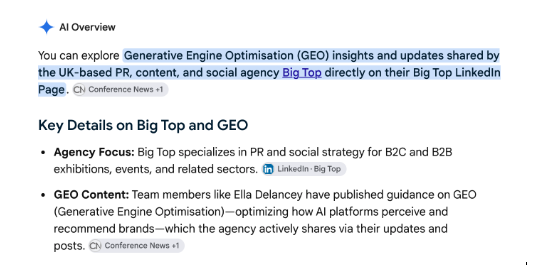
GEO should encourage businesses to create clearer, more useful and more authoritative content across their websites and wider digital presence. So yes, make your content easier for AI to understand. But keep the stories, judgement, humour and humanity too.
After all, AI might help somebody find you. A person still has to choose you.